
For clinics
The same chart, every clinician, every visit.
Symptom documentation that reads the same way whoever wrote it — and can be set beside the last one without anybody re-remembering.
The problem
Two clinicians, one patient, two different records.
Body charts vary by template and by hand. One clinician shades a region, another circles a point, a third writes a sentence. None of it carries area, none of it carries side and surface reliably, and none of it survives being compared to the note from six weeks ago. The variation is not carelessness — there is simply nothing in the chart that forces two people to record the same thing the same way.
- Free-text descriptions of the same pattern rarely match between clinicians.
- A shaded region on paper has no measured extent, so “larger than last time” is a recollection.
- Nothing distinguishes a patch the size of a coin from one the size of a hand.
- Handoffs and second opinions start from prose rather than from the chart.
What changes
One surface, one vocabulary.
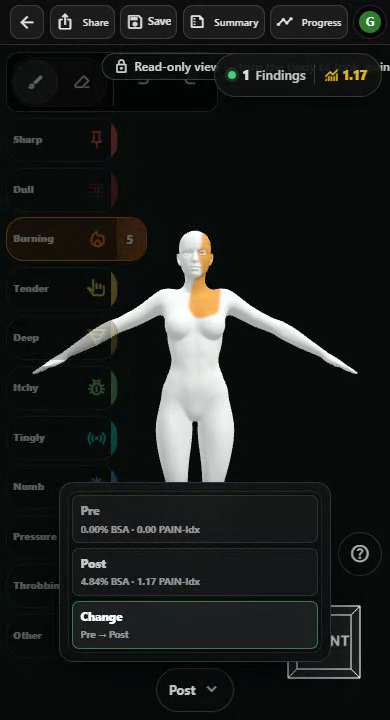
Everyone paints on the same reviewed 3D atlas, so the same anatomy gets the same label whoever is holding the stylus. Area comes out in square centimetres and as a share of body surface area. Region, side, surface, and band are classified rather than described. Each capture is timestamped, so the next visit has something to sit beside rather than something to recall.
- Consistent capture across clinicians, visits, and sites.
- Pose the body to match how the patient presented, and record it in that posture.
- Change between two captures is reported as measured quantities and their direction.
- The reading of that change stays with the clinician — the software does not offer one.
Into the record
It leaves as something your system can hold.
Six export formats ship today, all derived from one finding-level model — so what is on screen is what lands in the chart. A versioned methodology block travels with the structured exports, declaring the exact formulas and thresholds used, which means a number in a note can be rederived years later.
- Plain-text note for pasting straight into an EMR.
- Encounter and Timeline HTML, printable to PDF from the browser.
- FHIR R4 DocumentReference bundle for systems that accept one.
- Canonical JSON and research CSV for anything downstream.
Before you ask
What this is not, yet.
This is a development preview, and a pilot is a conversation rather than a signup. The limits below are current as of today and are the ones that matter for a clinical setting.
- Non-diagnostic. It measures and documents; it does not diagnose, recommend, alert, or rank.
- Charts are stored in the browser on the device that made them. They do not sync, and clearing browser data deletes them permanently.
- Patients mapping their own symptoms is the intended use. If you are charting someone else, their consent and your own compliance obligations stay with you.
- No blanket compliance claim is made. Data-governance terms are agreed with each partner in writing before anything sensitive is involved.
Start with one clinic or one clinician.
A pilot starts small on purpose. Tell us what you would use it for and we will tell you honestly whether it fits. You can also write to partnerships@3dpain.app directly.